Which account, why now, and who should we call?
Selling to a GCC needs more than a list of companies.
- ICP match
- Why now
- Decision-maker
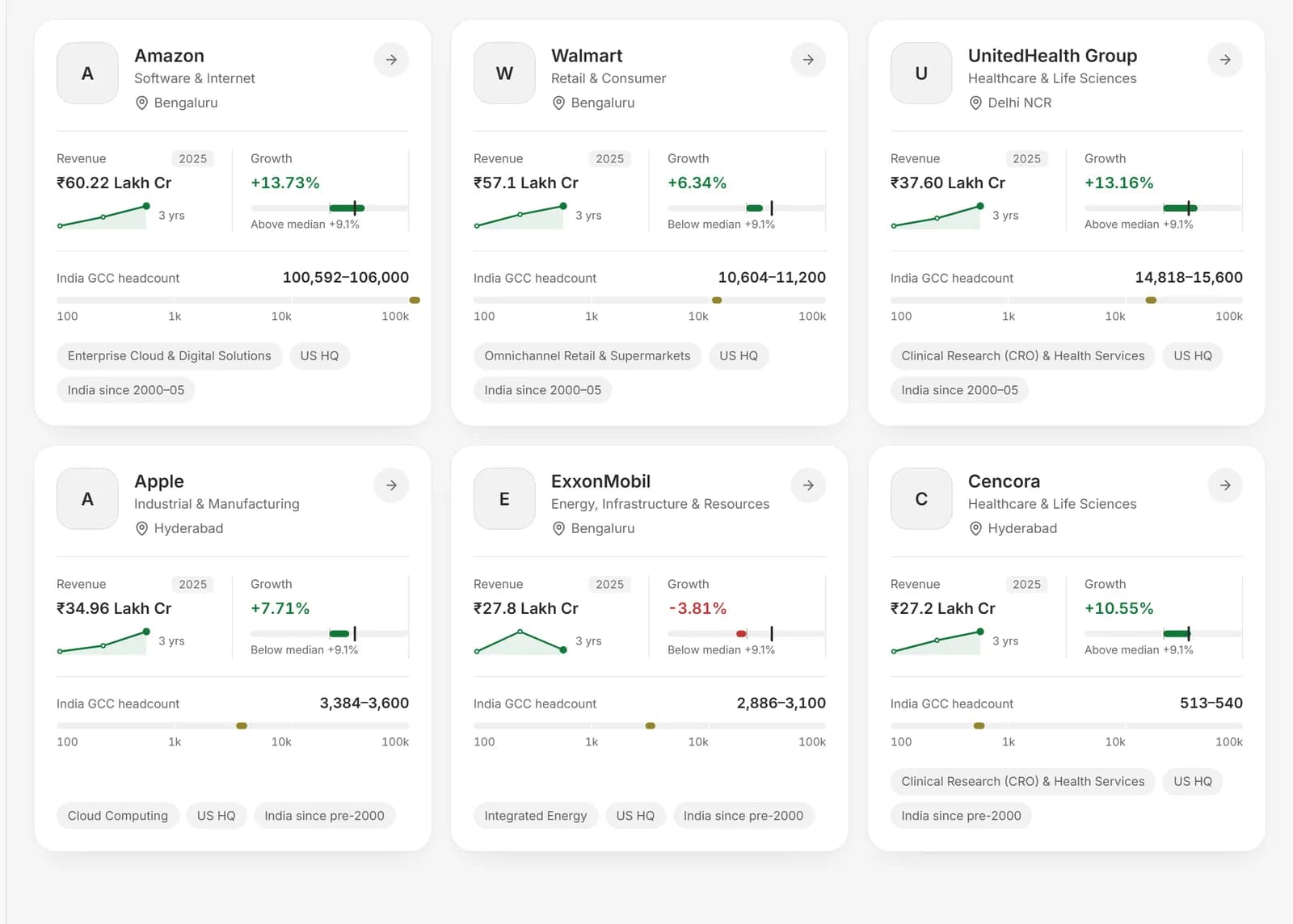
Inside the product · the target-account universe
What changed at the GCCs on our target list since last week?
Open full-size viewB2B GTM · account prioritisation
Prioritise GCC accounts by fit and change.
ICP match
Industry, location, workforce, capabilities, maturity and hiring profile.
What changed:ICP fit and centre context
Who to reach:Keep the signal connected to the account
Why now
Expansion, hiring, new capability, leadership change, recency and evidence strength.
What changed:Dated activity with evidence strength
Who to reach:Keep the signal connected to the account
Decision-maker
Buyer function and seniority connected to the centre's recent context.
What changed:Relevant function and seniority
Who to reach:Buyer context
Read the evidence
See what the product puts in front of you.
Choose a view to inspect. These are product captures; demo-data views are marked.

- 2,557
- company profiles
- 4,477
- GCC centres
- 10
- platform industries
- 33
- Indian cities with a centre
- Intelligence fields per company
- 300+
- Multidimensional company, workforce, hiring and market intelligence
- Daily expansion signals
- 100+
- Multi-source GCC establishment, expansion and capability signals
- Leadership profiles
- 500K+
- Senior professionals and leadership intelligence
- Business functions mapped
- 10+
- Technology, finance, operations, HR and other business functions
Go deeper
The detail behind the decision.
Open a chapter for the full context, the evidence to inspect and the limits of the view.
Chapter 01
Which account should we go after?
Build a target list that starts from your ICP and not from a generic database.
Read this chapter
Describe your ideal customer in terms that fit the GCC market: industry, location, size of the workforce, which capabilities and functions the centre runs, how mature it is, how fast it is hiring and growing, whether it has expanded. The result is a list of centres that match, not a search over company names.
Chapter 02
What should we know before reaching out?
Walk into the first conversation already knowing the centre.
Read this chapter
Open an account and read it before the first message: the organisation and its workforce, capabilities and locations, hiring and pay, leadership, expansion, its standing among peers and what changed recently.
Chapter 03
Which accounts deserve attention first?
Call the accounts where something real is happening first.
Read this chapter
Order the list on evidence you can read: how well the account fits the ICP, how current its activity is, expansion, hiring acceleration, a new capability, a leadership change, workforce growth, a move to a new location, how recent it all is and how strong the evidence is. The order is explained. It is not a hidden score.
Chapter 04
Why this account, and why now?
Open with what changed, not with a generic pitch.
Read this chapter
The signals come from the GCC itself: a new GCC, a workforce expansion, hiring acceleration, a new capability, a new location, a leadership appointment, a functional build-out, an investment in AI or technology, procurement activity, pressure in the talent market.
Signals show commercial relevance. They do not show that an account intends to buy, and they are never presented as if they did.
Chapter 05
Know when something changes
Return to an account with the latest change already in front of you.
Read this chapter
Keep priority accounts under watch. When one expands, hires faster, adds a location, gets a new leader or a new capability, or when its order in your list changes, you see what moved and when. You stop rediscovering the account every time you come back to it.
Chapter 06
Who owns the decision?
Pick the right person for what you sell.
Read this chapter
Find the people by function and seniority: the head of the centre, technology and engineering, AI and data, HR and talent acquisition, finance, procurement, operations and workplace, and the functional leaders. See their role, company and level, and what they are responsible for.
Chapter 07
Account context, the right buyer and a way to reach them
Send the first message knowing what to say.
Read this chapter
Professional contact information is available where it is held. What matters is that it arrives with the account context and the reason: who this is, what their centre has been doing and why it is relevant to you now. That context is as useful to a sales agent as to a salesperson.
Chapter 08
The sequence
Run the whole motion from one place.
Read this chapter
Discover the account, understand it, see what changed, prioritise it, find the buyer, get the contact and start the conversation. Each step uses the account's own data, so the team always knows which account, which person, why now, what happened and what to say.
From a target list to a first message
Each step reads from the account's record.
- Step 1
Discover
Accounts that fit the ICP.
- Step 2
Understand
The centre's workforce, hiring and leaders.
- Step 3
What changed
Recent, dated evidence.
- Step 4
Prioritise
Ordered on evidence you can read.
- Step 5
Buyer
Function and seniority.
- Step 6
Reach out
Contact, with the context.
Questions this evidence can answer.
- 01
Which GCCs in healthcare with more than two thousand people have added a location this year?
- 02
Why is this account ranked above the one next to it?
- 03
Who leads procurement at the centres on my target list?
- 04
What changed at my top fifteen accounts since last Monday?
- 05
Which accounts are hiring fastest in the function I sell into?
Coverage and limits
What is held today, and what is still next.
Held today
- 2,557 company profiles with workforce, locations, hiring and pay
- Verified, scored stories about set-ups, expansions, hiring moves and leadership changes
- Watchlists of companies
- Contact search by function and seniority, with details shown on request where held
Coming next
- Account lists ranked with the evidence beside each rank
- Change alerts on watched accounts
- Procurement and technology-investment signals
4 held today · 3 coming next
Definitions for this view
The terms on this page, defined.
Every figure on a CapSight page comes with its definition, so you never have to guess what a number is counting.
- GCC
- A Global Capability Centre: a centre a company runs in India for its own global work, such as engineering, analytics, finance, operations or support. It is part of the company, not an outside vendor.
- Platform Industry
- The one industry grouping CapSight uses for every company, so a filter or a chart means the same thing on every page. There are 10.
- Tier 1 and Tier 2 cities
- Tier 1 is the eight established hubs: Bengaluru, Chennai, Hyderabad, Mumbai, Pune, Delhi NCR, Kolkata and Ahmedabad. Every other city is Tier 2.
- Persona
- The person a role really needs, written out across role, seniority, skills, background and location before any profile is read.
- ICP
- Ideal customer profile: the kind of account a seller wants, described by industry, location, size and what the centre does.
- Signal
- A recorded change at a company, with its date and source. It shows an account is relevant now; it does not show that the account has decided to buy.
Take the next step
Start from your ideal customer.
Bring the profile of the account you want and see which GCCs match it today.