One question, answered across every dataset.
Ask CapSight.ai is part of CapSight.
- Company set
- Hiring activity
- Workforce context

Several evidence layers · one market question
Which BFSI GCCs are increasing Data and AI hiring?
Ask CapSight.ai / one question, several datasets
One market question can cross several datasets.
EXAMPLE QUESTION
“Which BFSI GCCs are increasing Data & AI hiring?”
Answer composition
Show how the answer is built.
Company set
Which GCCs
Hiring evidence
Roles and period
Workforce context
Scale and mix
COVERAGE LIMIT
If a source does not cover part of the question, keep that gap visible.
Read the evidence
See what the product puts in front of you.
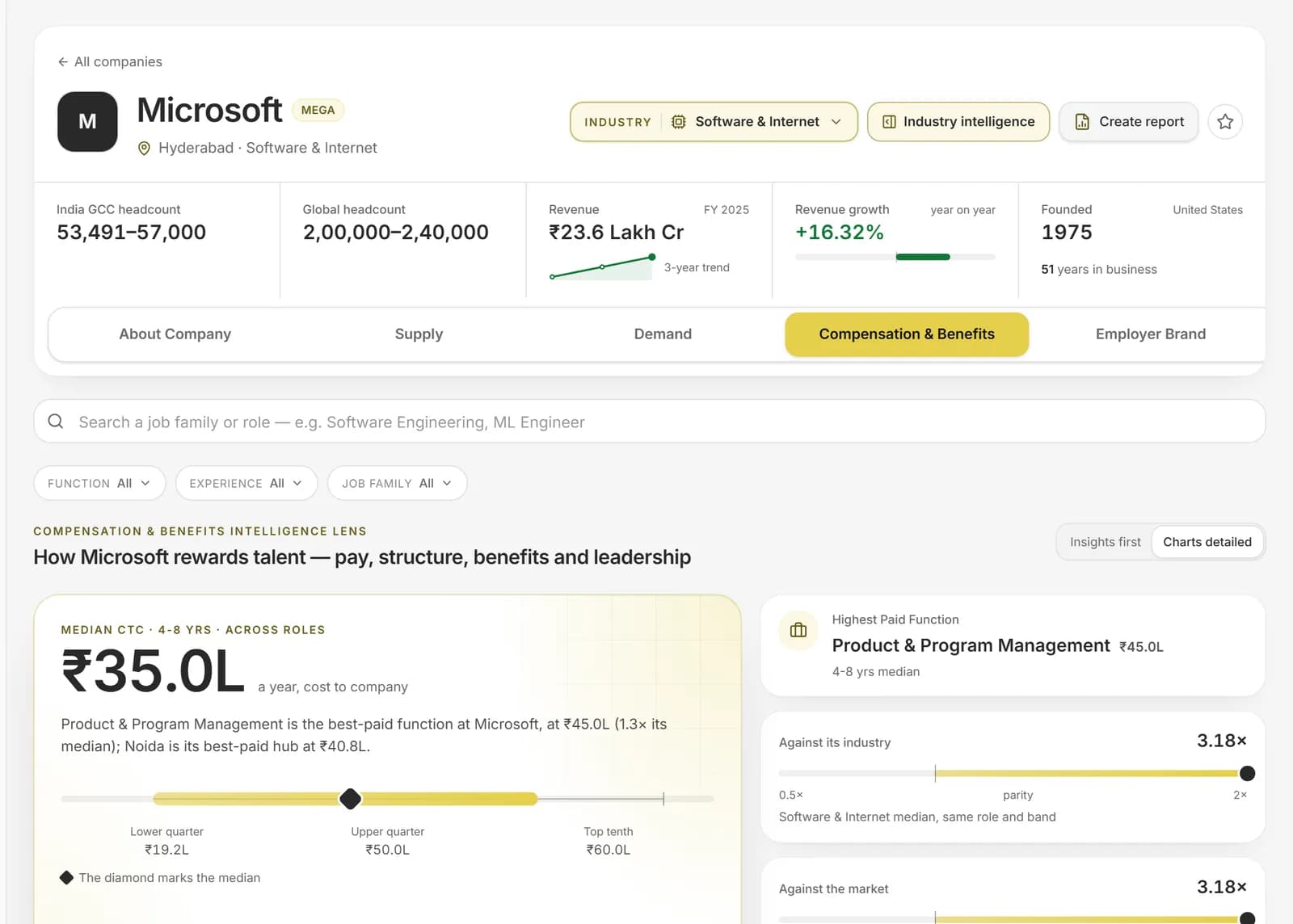
Choose a view to inspect. These are product captures; demo-data views are marked.
- 2,557
- company profiles
- 10
- platform industries
- 1,297
- companies with pay benchmarks
- 33
- Indian cities with a centre
- Intelligence fields per company
- 300+
- Multidimensional company, workforce, hiring and market intelligence
- Roles mapped
- 5,000+
- Standardised job roles and specialisations
- Skills mapped
- 60,000+
- Technical, functional and emerging skills
- Compensation data points
- 1M+
- Salary and compensation observations
Go deeper
The detail behind the decision.
Open a chapter for the full context, the evidence to inspect and the limits of the view.
Chapter 01
A question, not a filter
Get a combined answer without building it screen by screen.
Read this chapter
Most questions about the GCC market involve more than one dataset. Which BFSI centres are growing data hiring? What does a ten-year cybersecurity professional cost in Pune? Answering either by hand means a company filter, a hiring view and a pay table.
Ask it as you would to a colleague and the answer comes back built from all of them, with the figures it used.
Chapter 02
What a question can reach
Know what you can ask about, and expect it to be answered from the data.
Read this chapter
Companies and their descriptions. Workforce by function and seniority. Hiring activity from job postings. Pay percentiles and skill premiums. The movement of people between industries. Employer ratings. Recent expansion news. One question can use several at once.
- Companies and organisations
- Workforce and talent
- Hiring demand
- Compensation and skill premiums
- Movement between industries
- Expansion and news
Chapter 03
How a question becomes an answer
Trust an answer because you can see what it was built from.
Read this chapter
The question is read for what it needs: which companies, which measure, which period. Each part is looked up in the relevant dataset, and the results are put together in a short answer with the counts and figures it rests on. Where the data does not cover a question, the answer says so and does not fill the gap.
One question, several datasets
Which BFSI GCCs are increasing Data & AI hiring?
- Step 1
Companies
The BFSI GCCs on the list.
- Step 2
Hiring
Open roles in data and AI, month on month.
- Step 3
Workforce
Size and function mix for context.
- Step 4
Answer
A ranked short list, with the figures.
Chapter 04
Questions to start with
Start from a question that is already on your desk.
Read this chapter
Compare two GCCs across workforce, hiring and compensation. Which locations hold the deepest engineering talent for a given experience band? Which GCCs are expanding a particular capability? What changed in the last quarter among the centres on my list?
Chapter 05
From an answer to a document
Take an answer to a meeting.
Read this chapter
When an answer is going to be read by someone else, turn it into a report: the same figures laid out as pages with a source line under each one.
Questions this evidence can answer.
- 01
Which BFSI GCCs are increasing Data & AI hiring?
- 02
Where is 10+ year cybersecurity talent concentrated?
- 03
Compare two GCCs across workforce, hiring and compensation.
- 04
Which locations have the deepest engineering talent for the 8 to 12 year band?
- 05
Which GCCs are expanding a particular capability?
Coverage and limits
What is held today, and what is still next.
Held today
- Questions across companies, workforce, hiring, pay, skill premiums, movement, employer ratings and news
- Answers that state the figures they rest on
- Questions asked inside the signed-in product
Coming next
- Leadership and organisation questions
- Location and policy questions answered across states in one reply
- Saved questions that update when the data does
3 held today · 3 coming next
Definitions for this view
The terms on this page, defined.
Every figure on a CapSight page comes with its definition, so you never have to guess what a number is counting.
- GCC
- A Global Capability Centre: a centre a company runs in India for its own global work, such as engineering, analytics, finance, operations or support. It is part of the company, not an outside vendor.
- Platform Industry
- The one industry grouping CapSight uses for every company, so a filter or a chart means the same thing on every page. There are 10.
- Tier 1 and Tier 2 cities
- Tier 1 is the eight established hubs: Bengaluru, Chennai, Hyderabad, Mumbai, Pune, Delhi NCR, Kolkata and Ahmedabad. Every other city is Tier 2.
- Operating centre
- A company's presence in one city. A GCC with centres in three cities has three, which is why centres outnumber GCCs.
- Signal
- A recorded change at a company, such as a new site, a hiring surge or an appointment, with its date and source. A signal is evidence of activity, not of what the company intends.
- Median and percentiles
- The median (P50) is the middle value: half the sample sits below it. Percentiles show the spread around it, so a median is never quoted without its band.
Take the next step
Ask the first question.
Ask CapSight.ai is part of the signed-in product. Book a walk-through and bring a question of your own.