Where to build, whom to hire and what it will cost.
A GCC decision is usually made in a room where the location, the talent and the pay numbers come from three different decks.
- Location fit
- Team feasibility
- Cost and precedent

GCC leadership · location and workforce
Choose the city that can staff your mandate.
Location shortlist
Start with the role market.
Reading Bengaluru
What can this city support?
- 01
Location fit
GCC workforce, centres, hiring activity and state policy by city.
- 02
Team feasibility
Workforce by function and seniority, with peer hiring sources.
- 03
Cost and precedent
Annual pay spread by role and band beside documented peer journeys.
Illustrative location question. City selection marks the map; no city score is implied.
Read the evidence
See what the product puts in front of you.
Choose a view to inspect. These are product captures; demo-data views are marked.
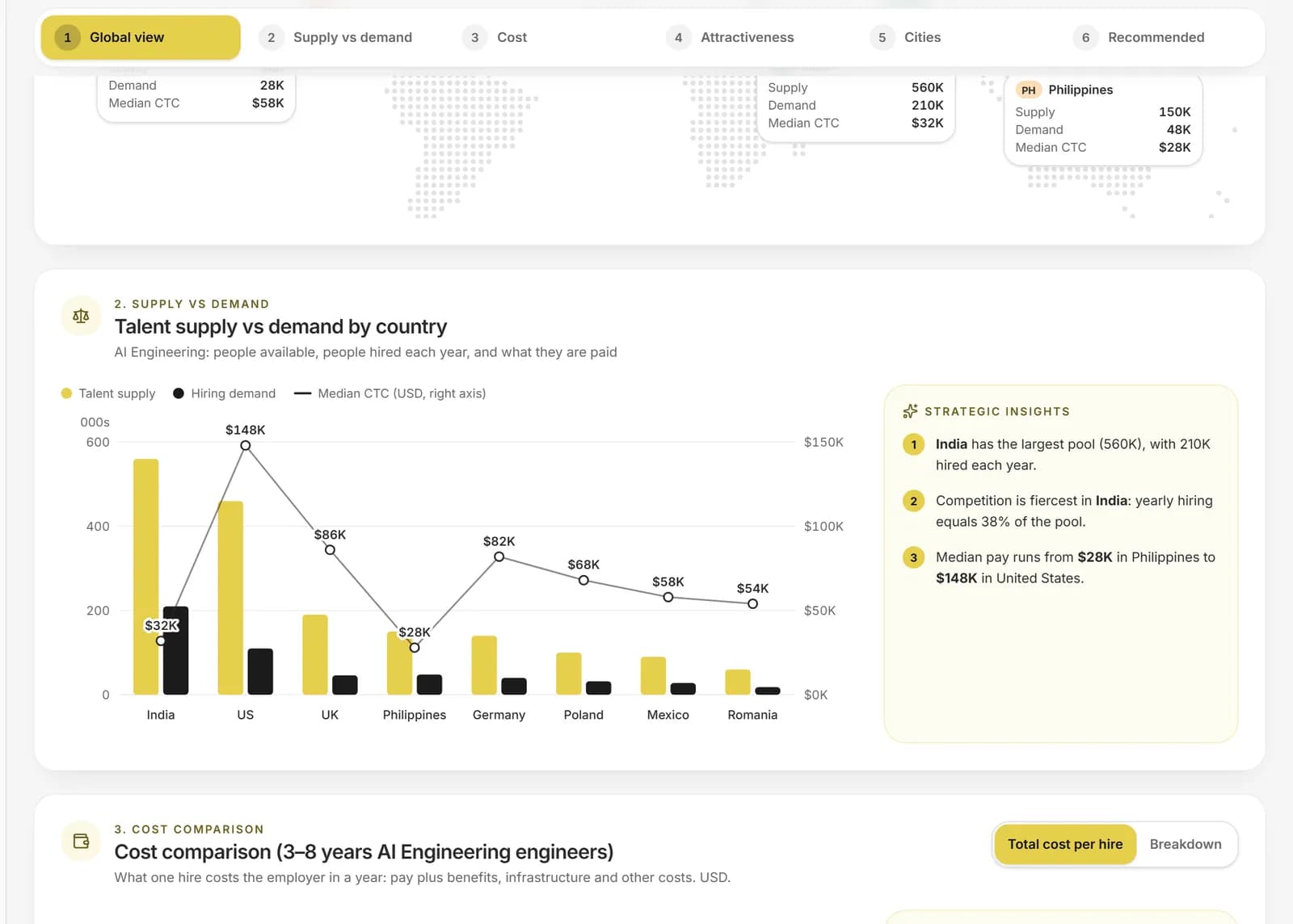 Sample data
- 2,557
- company profiles
- 33
- Indian cities with a centre
- 28
- documented build journeys
- 1,297
- companies with pay benchmarks
- Intelligence fields per company
- 300+
- Multidimensional company, workforce, hiring and market intelligence
- Business functions mapped
- 10+
- Technology, finance, operations, HR and other business functions
- Roles mapped
- 5,000+
- Standardised job roles and specialisations
- Skills mapped
- 60,000+
- Technical, functional and emerging skills
Go deeper
The detail behind the decision.
Open a chapter for the full context, the evidence to inspect and the limits of the view.
Chapter 01
Where should we build?
Narrow a long list to two or three cities, with the evidence for each one next to it.
Read this chapter
A shortlist of cities is easy to produce and hard to defend. The question the board asks is whether the city can staff the centre you described, in the time you described, at a cost the business case can carry.
CapSight puts the cities you are weighing side by side on the things that decide it: how many people already work in GCCs there, which capabilities those people sit in, how many roles are open now, what the same role costs, and what the state offers. The comparison is made for your capability, not for “GCCs in general”.
- GCC workforce and number of centres in each city
- Hiring activity for the role families you need
- Annual pay for the same role and experience band in each city
- State incentive policy and the office market
Four answers that have to agree
A location chosen without the talent and the pay behind it gets reopened six months later. The work runs in this order.
- Step 1
Where
Cities and states compared on workforce, hiring and policy.
- Step 2
What
The capability and ownership model, set against how peers started.
- Step 3
Whom
The supply of the roles you need in each city and band.
- Step 4
What it costs
Annual pay for those roles, with the market's spread.
Chapter 02
Can this market support the workforce we need?
Test a hiring plan against the people who are actually there, and see which roles will be the hard ones.
Read this chapter
Talent feasibility is not a headcount in a database. It is whether people with your skills, at your seniority, already work in GCCs in that city, and how many other centres are competing for them.
Read the workforce by function and seniority, where each peer's hires come from, and which skills are growing fastest. If the pool is thin, you see that before you commit, not after the third offer is declined.
Chapter 03
What will the talent cost?
Set a pay envelope per role and city before headcount is approved.
Read this chapter
Pay is read at four points, the 25th, 50th, 75th and 90th percentile of annual cost to company, for the role and experience band you will hire, in each city on your shortlist. Your industry's benchmark sits next to the market's, because a financial-services GCC does not pay what a retailer's does.
Run the hiring scenario you are considering: add thirty per cent to a team in a second city and see what it costs and how long it takes.
Chapter 04
How do we compare with similar GCCs?
See where your centre is ahead of its peers, where it is behind, and what the ones ahead did differently.
Read this chapter
Pick a target and its closest peers and read them on the same axes: size, growth, seniority mix, where they hire from, which skills they are adding, how the organisation is laid out and who leads each function.
Twenty-eight documented build journeys show how comparable centres actually started: the first city, the year, the mandate and what the first team did, each figure with its source.
Chapter 05
Which capability should we build next, and where?
Choose the next capability and the next location from the same evidence.
Read this chapter
Capability planning is a comparison against the centres that are further along. Read a capability by workforce depth, hiring intensity, senior talent and growth, for your centre and four peers, and the gaps are visible in a minute.
Second-city strategy is the same discipline applied to geography: the next city has to hold the capability you are adding, not simply be cheaper than the first. Policy and expansion activity sit beside the numbers, so you can see who else is already moving there.
Chapter 06
Take it to the leadership room
Move from analysis to a document your leadership team can read in one sitting.
Read this chapter
The output of this work is a document other people read. Describe the decision and the report is built from the same figures you were looking at, laid out for the room, with a source line under each one.
Questions this evidence can answer.
- 01
Which Indian cities can support a first engineering centre, and how did comparable centres start in each?
- 02
Can Hyderabad staff another 300 people in data and analytics without pushing pay up?
- 03
How does our centre compare with the other GCCs in our industry on seniority mix and growth?
- 04
Which capability are the fastest-growing peers adding that we have not started?
- 05
If we open a second city, which one holds the roles we need and what does it cost?
Coverage and limits
What is held today, and what is still next.
Held today
- 2,557 company profiles across 33 Indian cities
- 28 build journeys, each figure cited to its source
- Annual cost-to-company percentiles by city, role and experience band
- Workforce by function and seniority, and where peers hire from
- State and city profiles with incentive policy
- Capability comparison of one company against four peers (sample figures until the live data is connected)
- Hiring scenarios for a new or growing team
Coming next
- Benefits and pay structure by company
- Talent-supply pools by function and seniority, city by city
7 held today · 2 coming next
Definitions for this view
The terms on this page, defined.
Every figure on a CapSight page comes with its definition, so you never have to guess what a number is counting.
- GCC
- A Global Capability Centre: a centre a company runs in India for its own global work, such as engineering, analytics, finance, operations or support. It is part of the company, not an outside vendor.
- Platform Industry
- The one industry grouping CapSight uses for every company, so a filter or a chart means the same thing on every page. There are 10.
- Tier 1 and Tier 2 cities
- Tier 1 is the eight established hubs: Bengaluru, Chennai, Hyderabad, Mumbai, Pune, Delhi NCR, Kolkata and Ahmedabad. Every other city is Tier 2.
- CTC
- Cost to company: the annual total an employer commits to one person, shown in lakh rupees. One lakh is 100,000.
- Percentile band (P25, P50, P75, P90)
- P50 is the median: half the people in the sample earn less. P25 and P75 mark the edges of the middle half, and P90 marks the top tenth. A pay figure is always read with its band.
- Build journey
- A documented account of how a comparable centre started: its first city, its first team and how it grew, with each figure cited to its source.
Take the next step
Start with the decision in front of you.
Open the location view for the cities you are weighing, or put the whole question to Ask CapSight.ai.