The evidence a recommendation has to stand on.
An adviser is asked to say where a client should build, whether the talent is there and what it will cost, and then to defend the answer in front of the client's board.
- Entry precedent
- Market feasibility
- Client deliverable

GCC advisory · evidence for the recommendation
Make each recommendation traceable to evidence.
Source trail
Every recommendation starts somewhere.
- 1Entry precedentSourced build journeys with first city, year, mandate and growth.
- 2Market feasibilityRole depth, competition and pay across shortlisted cities.
- 3Client deliverableDesigned reports from platform figures, with Custom Research for bespoke questions.
Client-ready case
Which parts of this client's feasibility case need custom research?
Deliverable
Location and workforce findings, peer precedent and cost assumptions arranged for a client discussion.
For a question outside standard coverage, scope Custom Research with an analyst.
Read the evidence
See what the product puts in front of you.
Choose a view to inspect. These are product captures; demo-data views are marked.
- 2,557
- company profiles
- 33
- Indian cities with a centre
- 28
- documented build journeys
- 1,297
- companies with pay benchmarks
- Intelligence fields per company
- 300+
- Multidimensional company, workforce, hiring and market intelligence
- Compensation data points
- 1M+
- Salary and compensation observations
- States with policy coverage
- 12+
- State-level policy and incentive intelligence
- Daily expansion signals
- 100+
- Multi-source GCC establishment, expansion and capability signals
Go deeper
The detail behind the decision.
Open a chapter for the full context, the evidence to inspect and the limits of the view.
Chapter 01
GCC entry and location strategy
Present a location recommendation with the peer precedent and the market evidence side by side.
Read this chapter
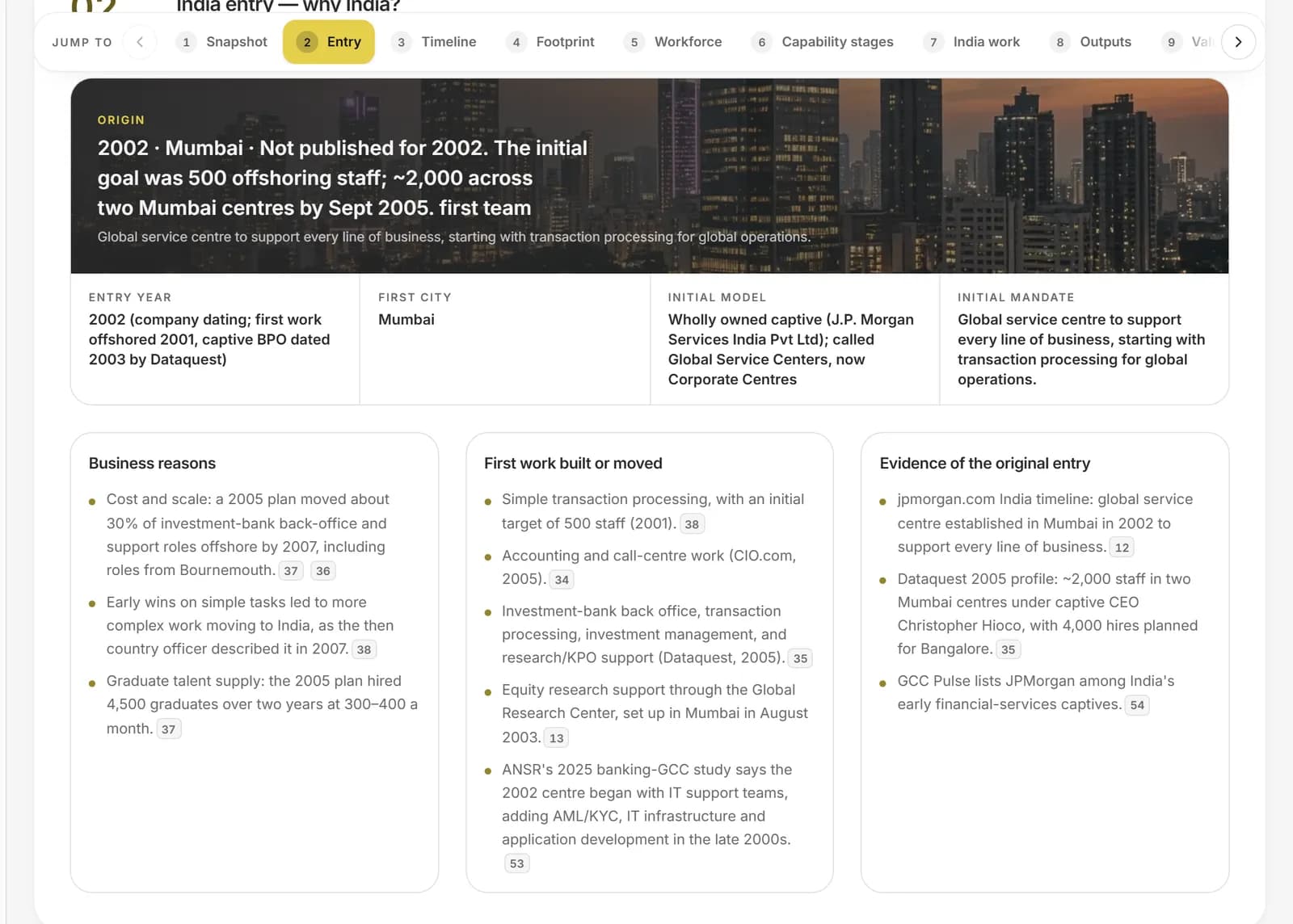
Start with where comparable companies went first and why. Documented build journeys show the first city, the year, the mandate and how the centre grew, with sources. Then test the cities the client is weighing on talent, pay, policy and the density of peers already there.
Chapter 02
Can the market staff the client's plan?
Show a client where its staffing plan is realistic and where it is not.
Read this chapter
Take the client's target team, role by role, and test it against the market in each shortlisted city: how deep the experience is, how many centres compete for the same skills, what the roles cost. Where the plan does not fit the market, you can say which roles and why.
Chapter 03
How have peer GCCs been built?
Back the recommended model with centres the client recognises.
Read this chapter
Compare the client's intended model with centres that did something similar: size at the same age, functions in the first team, the pace of growth, how the leadership is arranged. Competitive positioning is the same comparison pointed at the client's rivals.
Chapter 04
Operating scale, compensation and talent depth
Fill the assumptions of the client's business case with sourced figures.
Read this chapter
Benchmarks for scale, pay and the depth of the experienced pool are available at company, city and industry level, with the spread shown and not only the median. They go into the business case with a source line under each.
Chapter 05
Turn the evidence into a deliverable
Spend the time on the recommendation, not on assembling the exhibits.
Read this chapter
Describe the question and CapSight builds the report from the same figures: a location brief, a talent and pay study, a competitive benchmark. Pages are laid out for the client meeting, in PDF and as an editable presentation.
Chapter 06
When the question is not standard
Commission the part of the engagement the platform cannot answer alone.
Read this chapter
Some engagements need work no standard report covers: a feasibility study for a specific capability, a peer landscape for a client's industry, a bespoke analysis of one company. That is Custom Research: analysts working with CapSight data and structured market research on a brief you agree with them.
Questions this evidence can answer.
- 01
Where did comparable companies set up their first centre, and how big was the first team?
- 02
Is a 400-person analytics centre feasible in each of the three cities the client is considering?
- 03
Which GCCs in the client's industry are the right peer set for the business case?
- 04
What does the client's competitor pay for the same roles, and how does that compare with the market?
- 05
Which parts of this engagement need a custom study rather than a standard report?
Coverage and limits
What is held today, and what is still next.
Held today
- 28 build journeys, each figure cited to its source
- Annual pay percentiles by city, role and experience band
- City and state profiles with incentive policy
- Company profiles, peers and capability comparison
- Designed reports in PDF and editable presentation form
- Custom Research, commissioned with an analyst
Coming next
- Talent-depth pools by function and seniority by city
6 held today · 1 coming next
Definitions for this view
The terms on this page, defined.
Every figure on a CapSight page comes with its definition, so you never have to guess what a number is counting.
- GCC
- A Global Capability Centre: a centre a company runs in India for its own global work, such as engineering, analytics, finance, operations or support. It is part of the company, not an outside vendor.
- Platform Industry
- The one industry grouping CapSight uses for every company, so a filter or a chart means the same thing on every page. There are 10.
- Tier 1 and Tier 2 cities
- Tier 1 is the eight established hubs: Bengaluru, Chennai, Hyderabad, Mumbai, Pune, Delhi NCR, Kolkata and Ahmedabad. Every other city is Tier 2.
- CTC
- Cost to company: the annual total an employer commits to one person, shown in lakh rupees. One lakh is 100,000.
- Percentile band (P25, P50, P75, P90)
- P50 is the median: half the people in the sample earn less. P25 and P75 mark the edges of the middle half, and P90 marks the top tenth. A pay figure is always read with its band.
- Build journey
- A documented account of how a comparable centre started: its first city, its first team and how it grew, with each figure cited to its source.
Take the next step
Bring the next engagement's question.
Start with a report from a sentence, or commission research for a question that does not fit one.