Know whether you can close it before you start sourcing.
A mandate arrives and the first question is not who to call.
- Pool shape
- Where to source
- Budget check

Recruitment & staffing · mandate feasibility
Know the pool before accepting the mandate.
The incoming mandate
Is the budget realistic for a senior cloud security engineer in Pune?
Before saying yes
Evidence to weighPool shape
Relevant experience, GCC background, skills and location distribution.
ThenWhere to source
Employer concentration and competing hiring activity for the profile.
ThenBudget check
Annual CTC percentiles for the role, city and experience band.
Read the evidence
See what the product puts in front of you.
Choose a view to inspect. These are product captures; demo-data views are marked.
- 2.99M
- people in GCCs across India
- 46
- mega GCCs, over 10,000 people
- 2,557
- company profiles
- 33
- Indian cities with a centre
- Roles mapped
- 5,000+
- Standardised job roles and specialisations
- Skills mapped
- 60,000+
- Technical, functional and emerging skills
- Daily workforce movement signals
- 2,500+
- Observed career and workforce transitions
- Compensation data points
- 1M+
- Salary and compensation observations
Go deeper
The detail behind the decision.
Open a chapter for the full context, the evidence to inspect and the limits of the view.
Chapter 01
Can we realistically close this mandate?
Decide whether to take the mandate, and what to say about timelines before you do.
Read this chapter
Taking a mandate you cannot fill costs more than turning it down. Before the first search, see how many people in the market match the role, the skills and the experience band, how many of them work for GCCs, and how many other companies are hiring for the same profile right now.
A narrow pool and heavy competing demand is a different conversation with the client than a deep pool and quiet demand.
Chapter 02
Where the talent sits
Decide which employers to approach first and which cities to open.
Read this chapter
See which companies employ the people you want, how concentrated the pool is in a handful of employers, which cities hold it and how it splits by experience. Previous and current employers are both visible, so you can tell who has been building this profile for years and who is only starting.
- Employer concentration: the few companies that hold most of the pool
- Location distribution and the roles open in each city
- GCC-experienced talent against the wider market
- Skills that appear together in the strongest profiles
Chapter 03
Is the budget realistic?
Reset the brief with the client on evidence, or confirm it is workable.
Read this chapter
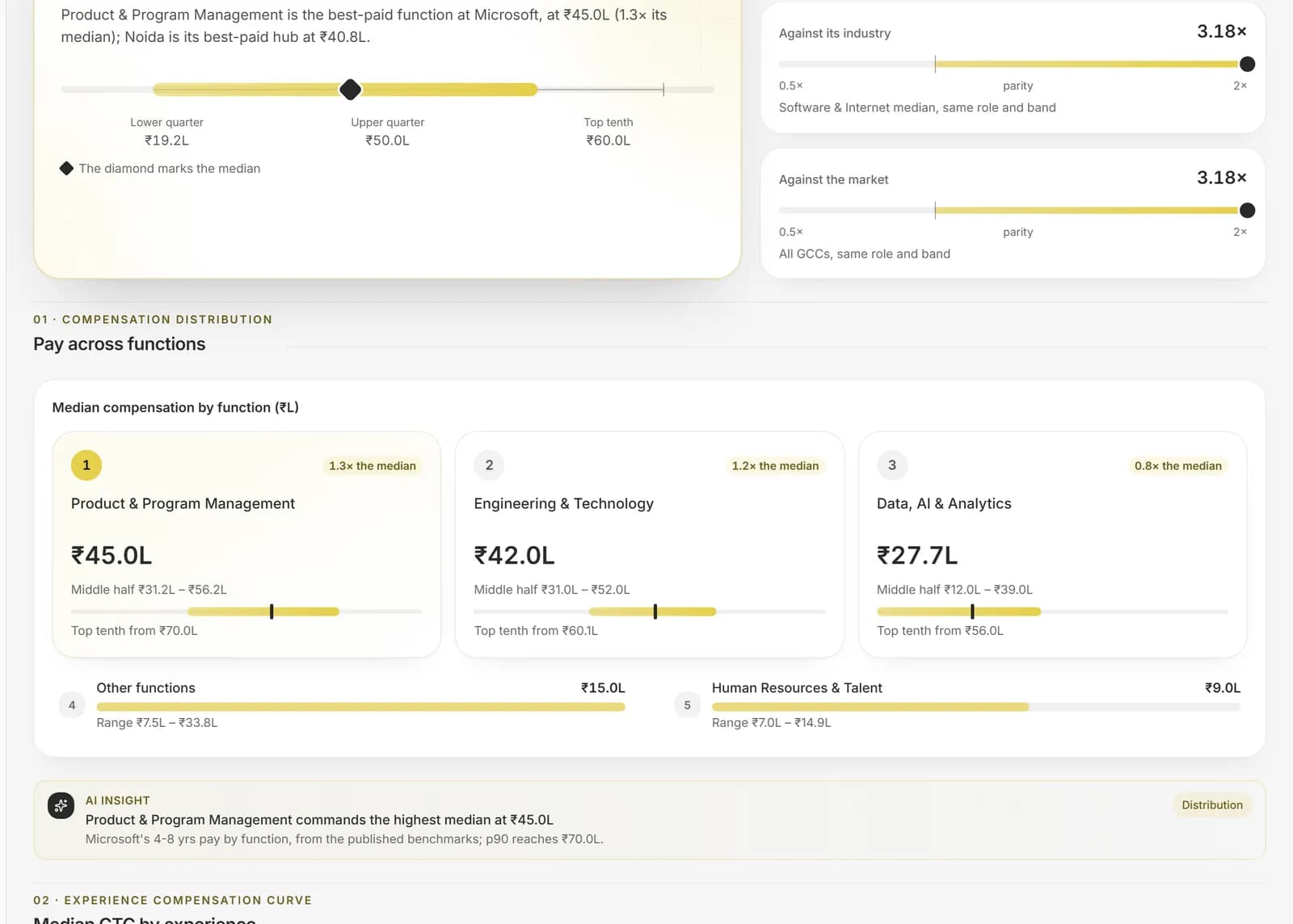
A client's number is a hypothesis. Compare it with annual cost to company for that role, in that city, at that experience, across the 25th to 90th percentile. If the budget sits below the 25th percentile, you know before sourcing starts, and you have the benchmark to show the client.
Chapter 04
Which adjacent profiles could still fit?
Widen the search in controlled steps and tell the client what changed and why.
Read this chapter
When the direct pool is too small, widen it deliberately. Related titles, comparable skills, a neighbouring industry, a nearby city, one level of seniority either way. Each step is shown with the reason it was included and the effect on the size of the pool, so a wider search never becomes a random one.
Chapter 05
From requirement to shortlist
Leave with a shortlist and an order to contact people in.
Read this chapter
Describe who you need in your own words. CapSight reads it as a persona, resolves the titles and skills that mean the same thing across GCCs, and brings back the closest profiles with the reason each one surfaced. Move the ones you want into a shortlist and compare them on the points that matter to the mandate.
Where contact details are held, they are available from the same screen, so the shortlist and the first outreach are one step apart.
From a mandate to the first call
The Sourcing page shows this sequence in full.
- Step 1
Requirement
The role as the client described it.
- Step 2
Persona
Who the role really needs.
- Step 3
Talent universe
The relevant market, before any profile.
- Step 4
Shortlist
The closest profiles, with the reason each fits.
Questions this evidence can answer.
- 01
How big is the real pool for a senior cloud security engineer with GCC experience in Pune?
- 02
Which five employers hold most of the people who match this persona?
- 03
Is a budget of 38 lakh realistic for this role at ten to twelve years of experience?
- 04
Which skills are making this search hard, and which adjacent skill could replace one?
- 05
Which of the people on this shortlist should we contact first, and why?
Coverage and limits
What is held today, and what is still next.
Held today
- Pay percentiles by role, city and experience band
- Workforce by function and seniority, by company and city
- Hiring activity from job postings, by role and city
- Contact search: describe who you need and see the closest profiles
- Shortlists of people, with contact details where held
Coming next
- The full talent-universe view with employer concentration for a single requirement
- Ranked pool with the reason each profile surfaced
5 held today · 2 coming next
Definitions for this view
The terms on this page, defined.
Every figure on a CapSight page comes with its definition, so you never have to guess what a number is counting.
- GCC
- A Global Capability Centre: a centre a company runs in India for its own global work, such as engineering, analytics, finance, operations or support. It is part of the company, not an outside vendor.
- Platform Industry
- The one industry grouping CapSight uses for every company, so a filter or a chart means the same thing on every page. There are 10.
- Tier 1 and Tier 2 cities
- Tier 1 is the eight established hubs: Bengaluru, Chennai, Hyderabad, Mumbai, Pune, Delhi NCR, Kolkata and Ahmedabad. Every other city is Tier 2.
- CTC
- Cost to company: the annual total an employer commits to one person, shown in lakh rupees. One lakh is 100,000.
- Percentile band (P25, P50, P75, P90)
- P50 is the median: half the people in the sample earn less. P25 and P75 mark the edges of the middle half, and P90 marks the top tenth. A pay figure is always read with its band.
- Build journey
- A documented account of how a comparable centre started: its first city, its first team and how it grew, with each figure cited to its source.
Take the next step
Take the next mandate through it.
The Sourcing page walks one requirement from persona to shortlist, step by step.